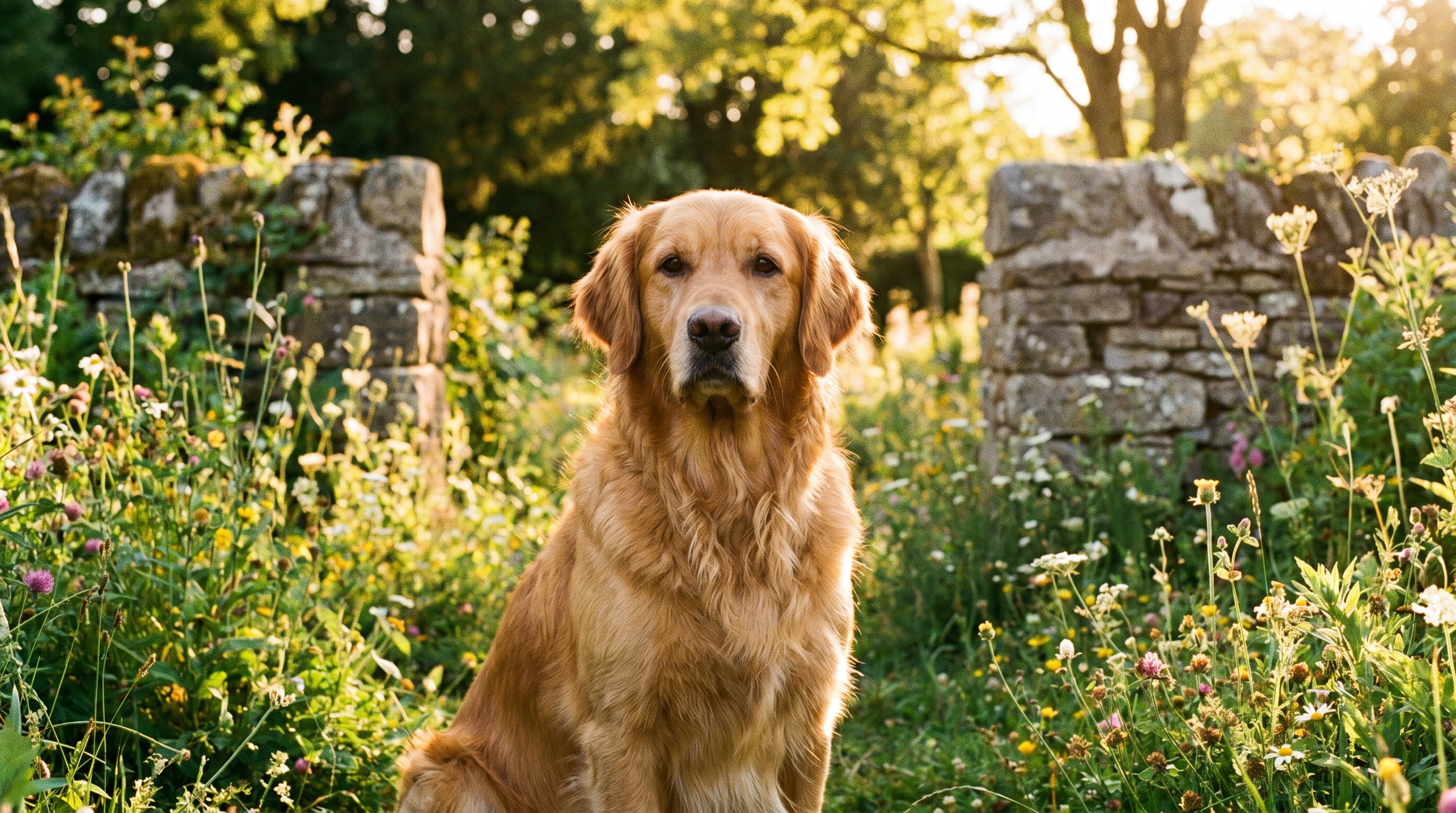
Traits & Temperament
Few breeds combine the Golden Retriever's eagerness to please with such a genuinely warm temperament. These are not trained behaviours — they are woven into the breed's DNA over generations of close collaboration with people. Scores below are relative within the breed, not absolute measures.
A Dog That Lives to Love
The Golden Retriever is, by almost any measure, one of the most emotionally intelligent dog breeds in the world. Originally bred as a working gun dog in the Scottish Highlands, the breed was designed to work closely alongside humans for hours at a stretch — a purpose that shaped not only their physical stamina but their deep-seated desire to cooperate and connect. That heritage is everywhere in a Golden Retriever's personality today.
What distinguishes Goldens from other friendly breeds is the quality of their attentiveness. They read human emotions with uncanny accuracy, responding differently to a tearful moment on the sofa than to the excited shuffle of a morning walk. This is not coincidence — it is the result of generations of selective breeding for cooperation and sensitivity. Therapy dog programmes around the world favour the Golden Retriever precisely because of this emotional fluency.
As family dogs, they are close to unmatched. Their patience with young children is exceptional, and their tolerant, gentle nature means they rarely escalate conflict. They are far more likely to retreat than to snap. Around other dogs, they tend to be sociable and easy-going, rarely showing aggression even when provoked.
They are not a breed that tolerates solitude well. Goldens form intense bonds with their families and experience genuine distress when left alone for extended periods. Give a Golden Retriever the company and engagement they crave, and they will return it tenfold for every year of their life.
A Scottish Legacy
The Golden Retriever's origins are traceable to the Scottish Highlands of the 1860s. Dudley Marjoribanks — later Lord Tweedmouth — is credited as the breed's founder, meticulously recording his breeding programme at his Guisachan estate near Tomich. His studbooks, preserved and eventually passed to the Kennel Club in 1952, revealed a cross between a yellow-coloured Flat-Coated Retriever and a Tweed Water Spaniel, a breed now extinct.
Subsequent crosses brought in Irish Setter and Bloodhound lines. Tweedmouth's goal was a working retriever ideally suited to the demanding terrain and wet climate of the Scottish Highlands — a dog with the nose to find fallen game, the athleticism to cover rough ground, and the temperament to work alongside hunters without complaint. The result was a breed of rare physical and psychological balance.
The Golden Retriever was officially recognised by the Kennel Club in 1911 — initially under the name "Retriever — Yellow or Golden." The same qualities that made the Golden such a superior working dog — willingness, intelligence, and emotional sensitivity — translate seamlessly into life as a companion. It is, in every sense, a breed built to be alongside people.
Care & Maintenance
Exercise
Golden Retrievers require at least two hours of exercise per day. Walks, swimming, fetch, and off-lead runs all count. Without sufficient activity, pent-up energy converts rapidly into destructive behaviour. A tired Golden is a well-behaved Golden.
Grooming
That beautiful double coat sheds prolifically, particularly twice a year during seasonal transitions. Weekly brushing year-round, stepping up to daily during moulting seasons, keeps the coat healthy. Professional grooming every 6–8 weeks is recommended.
Nutrition
Goldens are enthusiastic eaters who lack a meaningful "full" signal — portion control is essential. A high-quality complete food appropriate for their life stage supports joint health and maintains healthy weight. The breed is prone to obesity, which compounds the risk of hip dysplasia and arthritis.
Health Checks
Annual veterinary examinations, hip and elbow scoring before breeding, and regular eye tests are standard. The breed has elevated rates of certain cancers and cardiovascular conditions. Buying from health-tested parents significantly reduces risk.
Mental Stimulation
Physical exercise alone is insufficient. Goldens are intelligent working dogs who need mental engagement — training sessions, puzzle feeders, scent games, and learning new commands. A mentally stimulated Golden is calmer, more focused, and considerably less likely to redecorate your home.
Cost Snapshot
Golden Retrievers are a significant financial commitment. Below are realistic cost estimates for the UK and United States based on current market averages.
United Kingdom
| Expense | Estimated Cost |
|---|---|
| Puppy (KC registered breeder) | £1,500 – £3,500 |
| Monthly food | £60 – £90 |
| Annual vet check | £50 – £100 |
| Pet insurance (monthly) | £35 – £70 |
| Professional grooming | £40 – £80 per session |
| Training classes | £80 – £200 per course |
United States
| Expense | Estimated Cost |
|---|---|
| Puppy (AKC registered breeder) | $1,500 – $3,500 |
| Monthly food | $60 – $100 |
| Annual vet check | $50 – $150 |
| Pet insurance (monthly) | $40 – $80 |
| Professional grooming | $60 – $100 per session |
| Training classes | $100 – $250 per course |
Use our interactive Dog Cost Calculator to see a tailored breakdown across your dog's full lifetime.